Hugues Thiebeauld
|
0
|
November 19, 2026



In October 2026, attackers reached into French supermarkets and turned the refrigeration up instead of down. Cases that should have held produce near freezing were driven toward room temperature and beyond; food spoiled, and in places the overworked equipment caught fire. On the night of 11–12 October 2026, attackers broke into the controllers and changed their defrost settings to high temperatures. CERT-FR reported numerous compromised refrigeration controllers made by Danfoss, and similar incidents followed in other European countries. On 9 November 2026, the French government formally attributed the October operation to Shahid Kaveh, a cyber-offensive unit linked to Iran's Islamic Revolutionary Guard Corps, estimating food losses in the tens of millions of euros and summoning Iran's ambassador; France's cybersecurity agency cautioned against assuming the same actor was behind every later refrigeration incident.
The controllers at the center of it are small Linux computers that sit on the store network and, too often, on the open internet. In the October attacks these Danfoss units were the target itself: the controller is what sets each refrigeration case's temperature and raises its alarms, so taking one over is exactly what let attackers drive the cases to damaging temperatures and silence the warnings. Danfoss shipped a software update, package 5.4.0, and said little about what it changed. We wanted a precise answer to one question: does this update actually make the controller safer? This post is about how we answered it in an afternoon, identified security-relevant observations and documented the results for further assessment, and prepared a vulnerability report for the vendor, and what that says about analyzing firmware in general.
These controllers manage temperature, alarms and reporting for a whole store's refrigeration. If someone can log in without permission or run commands on the device, they can silence alarms and change setpoints: exactly the behavior seen in the attacks.
Two sets of weaknesses were already public. In 2025, researchers disclosed three flaws in the web interface, fixed in an earlier release: a hidden daily-login bypass (CVE-2025-41450), a command injection through the email settings (CVE-2025-41451) and an nginx header-file injection (CVE-2025-41452). Then, around the time of the attacks, a second team reported six more flaws that allow takeover without logging in, affecting every version up to 5.3.2, with technical details withheld during disclosure. The open question hanging over 5.4.0 was whether it closed these holes or merely bumped a version number.
The stakes are not abstract. Thousands of these controllers were reachable from the internet, each one a door into a store's operations and a lever on its food safety. An update that looks like a fix but isn't leaves operators believing they are protected when they are not.

Release notes are not evidence. A vendor saying an update "improves security" tells you nothing about which code changed, whether the fix is complete, or whether something new was introduced. We wanted to judge 5.4.0 from its own binaries.
The package is not a tidy firmware image. It is a signed archive holding an application update for an ARM Linux system: the main control program, a web backend, helper daemons, shared libraries, shell scripts, and separate firmware for a small co-processor. There is no operating system to boot, no device in front of us, just the code.
We approached it two ways at once. First, rehost and run the actual functions, feeding them chosen inputs and recording exactly what they did. Second, get hold of the previous package, version 5.1.1, but also a previous 4.2.4 package, and compare the versions directly, so that "what changed" came from the code execution analysis rather than the changelog.
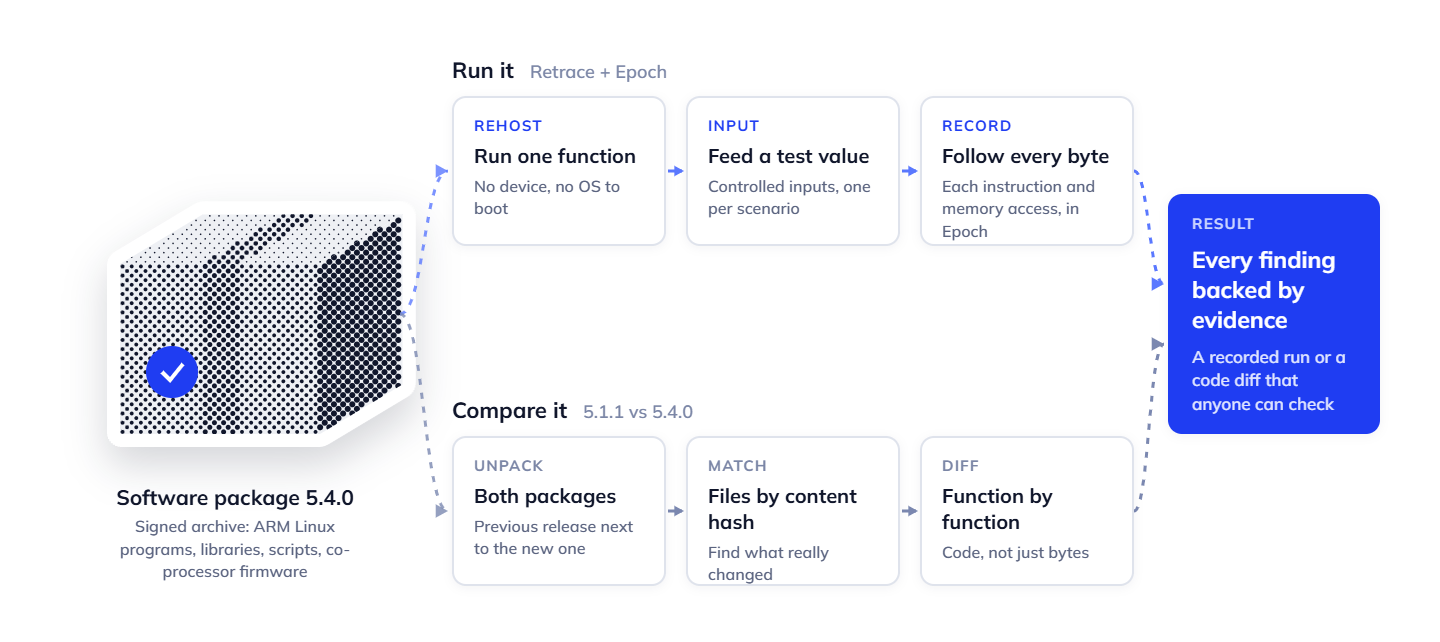

The update we examined is almost entirely the Linux side at the top. The co-processor firmware, highlighted, is a separate bare-metal program that takes commands over a serial link and actually drives the cooling; it has no network of its own, which is why the network-facing weaknesses all live in the Linux programs.
Working from the extracted code, we reached solid conclusions in a single session, each backed by a recorded execution rather than a hunch.
None of these came from reading disassembly and guessing. Each is the end of a traced path: we fed a function a harmless test value and watched where every byte of it ended up. For example, execution traces allowed us to assess how security-relevant inputs were processed and whether existing protections behaved as intended. The overflow is a counter of how many bytes spilled past the end of a record.
The point is the speed. Reaching defensible, evidence-backed answers about an unfamiliar 72 MB binary in hours, not weeks, is what changes firmware review from an occasional audit into something you can do on every release.
To build solid evidence, we used our tools to replay the weaknesses on the previous versions and validate that the same scripts no longer worked on 5.4.0:
We won't disclose findings in 5.4.0 in this post. We have not assigned CVSS ratings or confirmed exploitability on physical hardware. A vulnerability report was sent to Danfoss and, through coordinated disclosure, to the relevant national CERT; the specifics stay private until the vendor has responded, and the most serious finding was flagged to Danfoss's product security team as a priority ahead of this write-up.
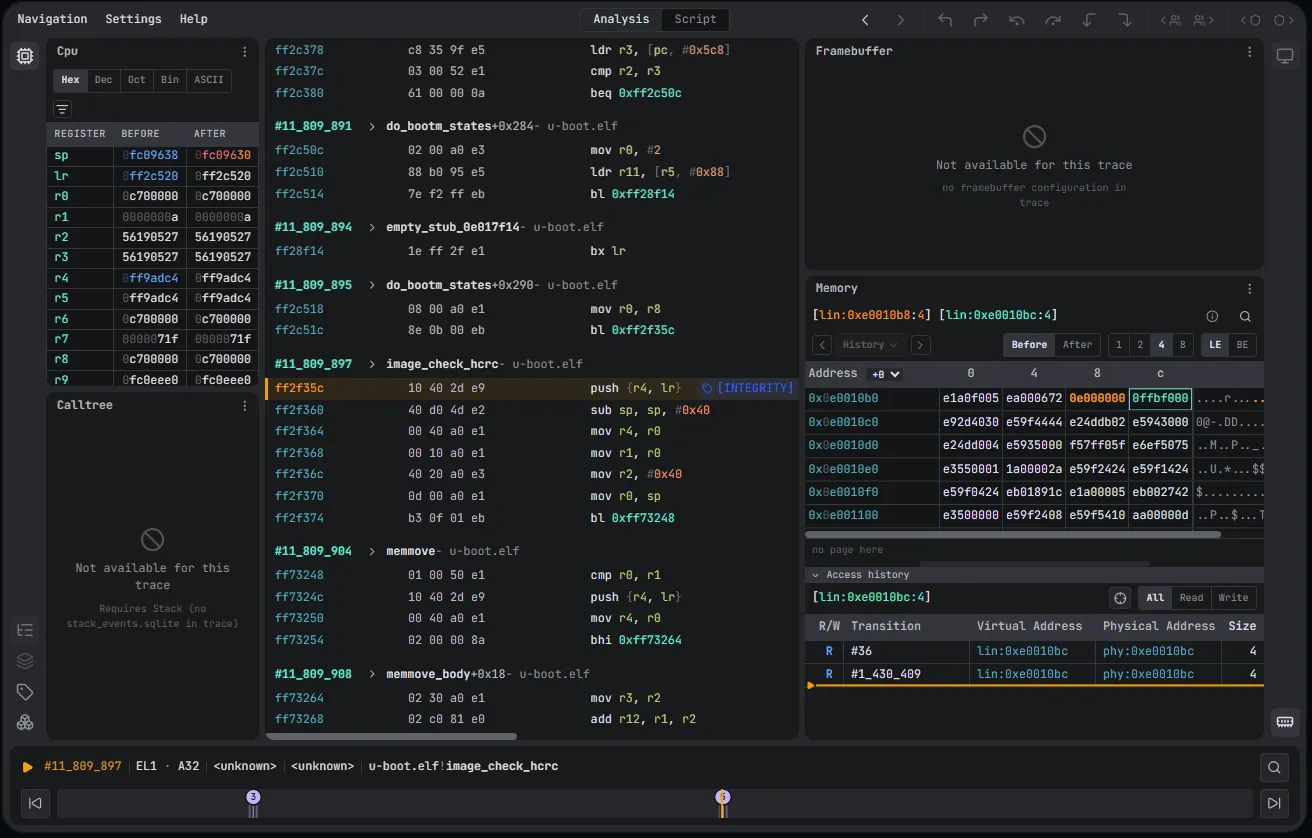
For every finding, we built evidence such as time travel debugging traces, where the code execution was recorded in a trace.
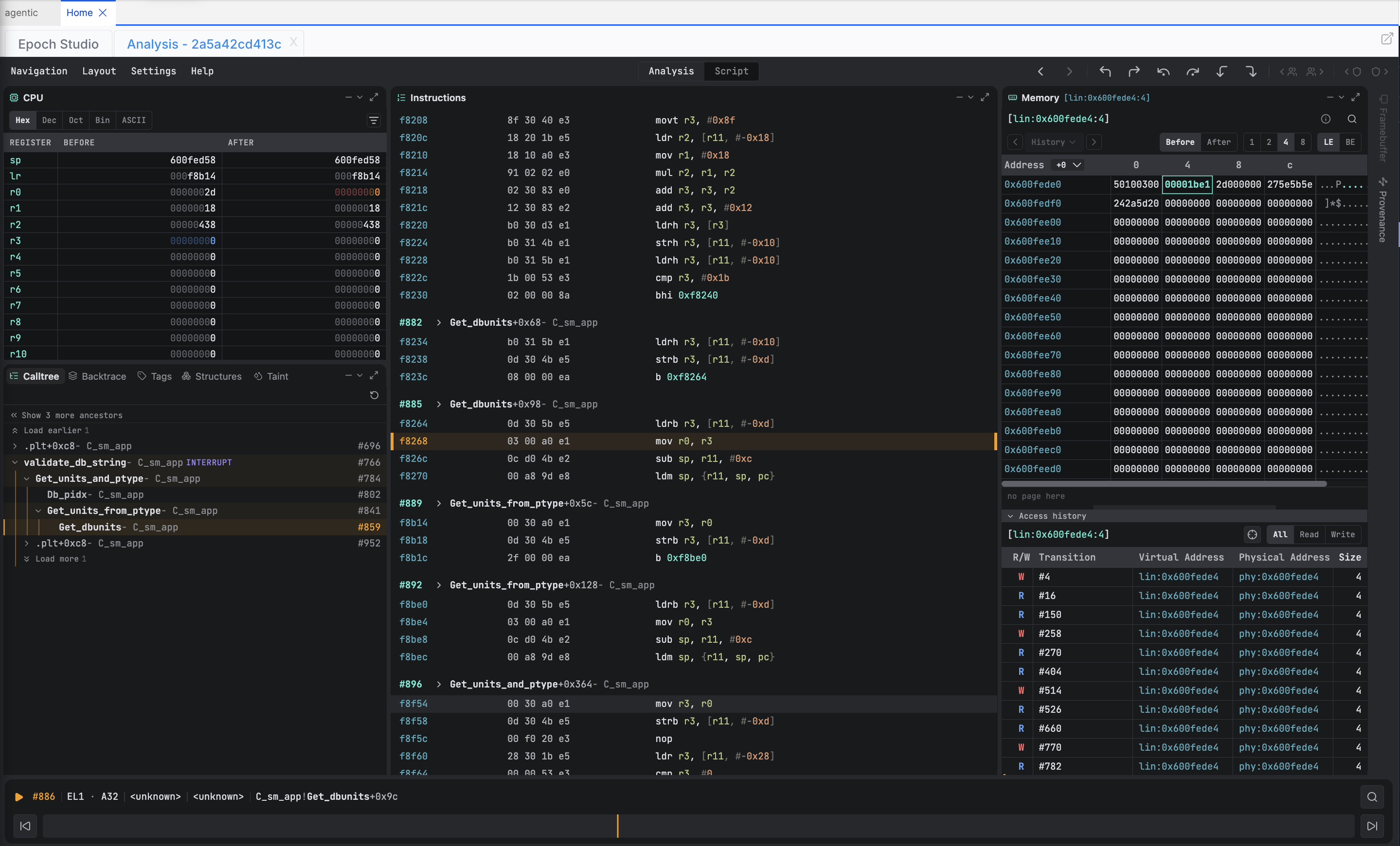
Execution traces provide evidence of observed behavior, complemented by static analysis to support our findings.
Comparing 5.4.0 against the earlier 5.1.1 package turned "the vendor says it improved security" into a concrete list. We unpacked both, matched files by content hash, and compared the changed programs function by function.
The diff told a story the release notes did not. 5.4.0 quietly tightened the check that decides whether an unsigned update may be installed, hardened the web login code that runs before authentication, and removed an unexplained user account and a leftover network service. The analysis also highlighted areas of residual security risk that warrant further investigation. The version comparison also provided additional context for security findings shared privately with the vendor.
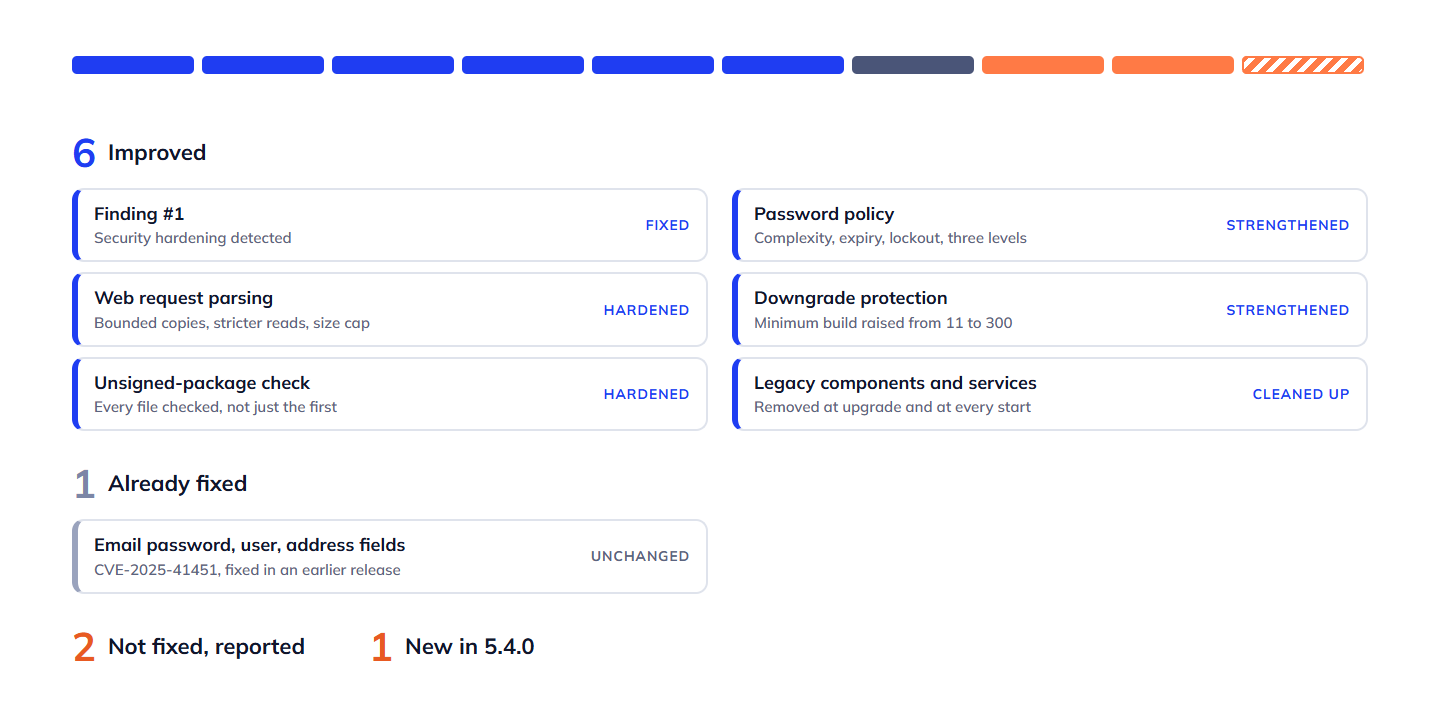
A version-to-version diff is where this kind of analysis earns its keep. It separates real fixes from cosmetic ones, finds changes the vendor did not document, and shows whether a newly reported flaw was ever actually addressed. Doing it at the level of individual functions, rather than whole files, is what makes the comparison trustworthy: two binaries can differ in a million incidental bytes and still behave identically, so the comparison has to understand code, not just bytes.
Ordinary debugging runs forward: you set a breakpoint, inspect the moment, and if you stepped past what you needed, you start over. Time-travel debugging records the whole execution once, then lets you move freely through it, forward and backward, asking questions of any moment. Every memory read, every value a register held, every branch taken, is there to query after the fact.
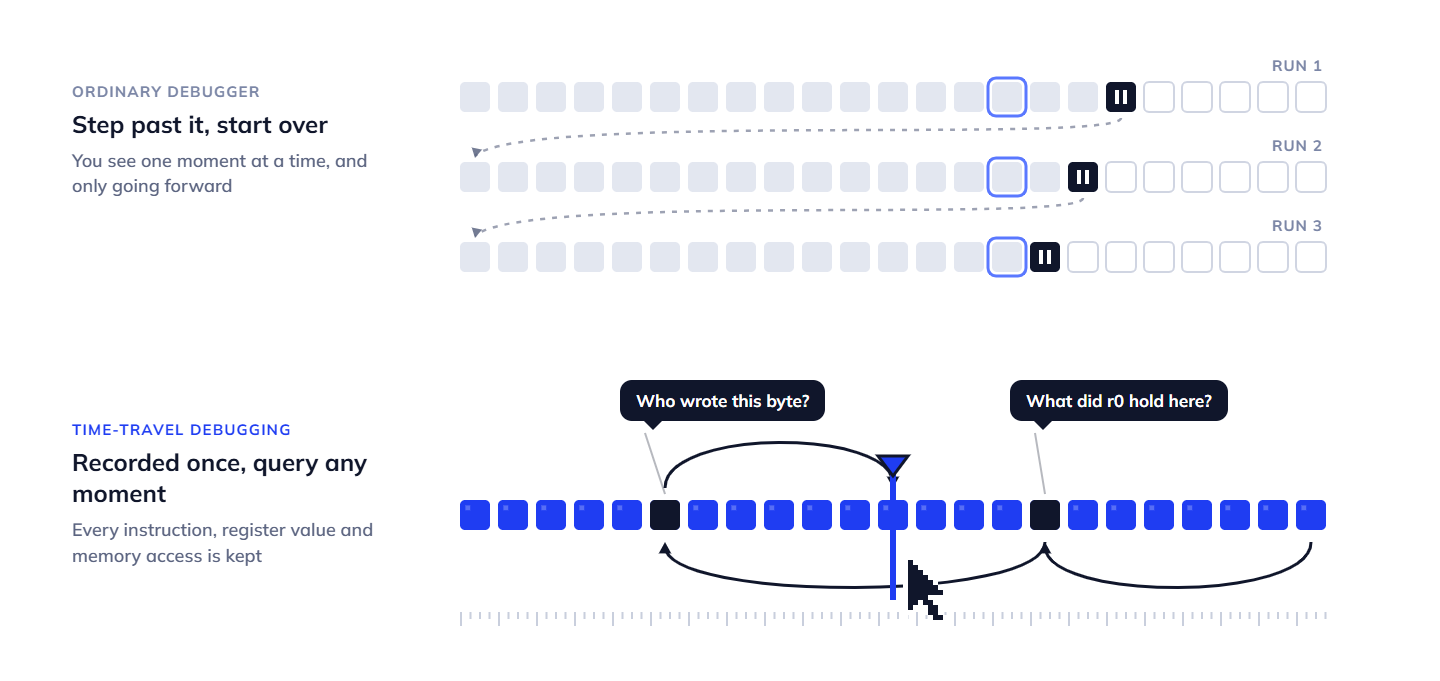
This is what made the Danfoss work fast. There was no device to attach to and no system to boot, only application binaries lifted from an update package. Retrace rehosts that code and runs just the function in question, fed an input we choose, while recording every instruction and every byte it touches. We never had to rebuild a working controller; each suspect path was exercised on its own, in seconds, with controlled test inputs designed to assess how the code handles different execution scenarios.
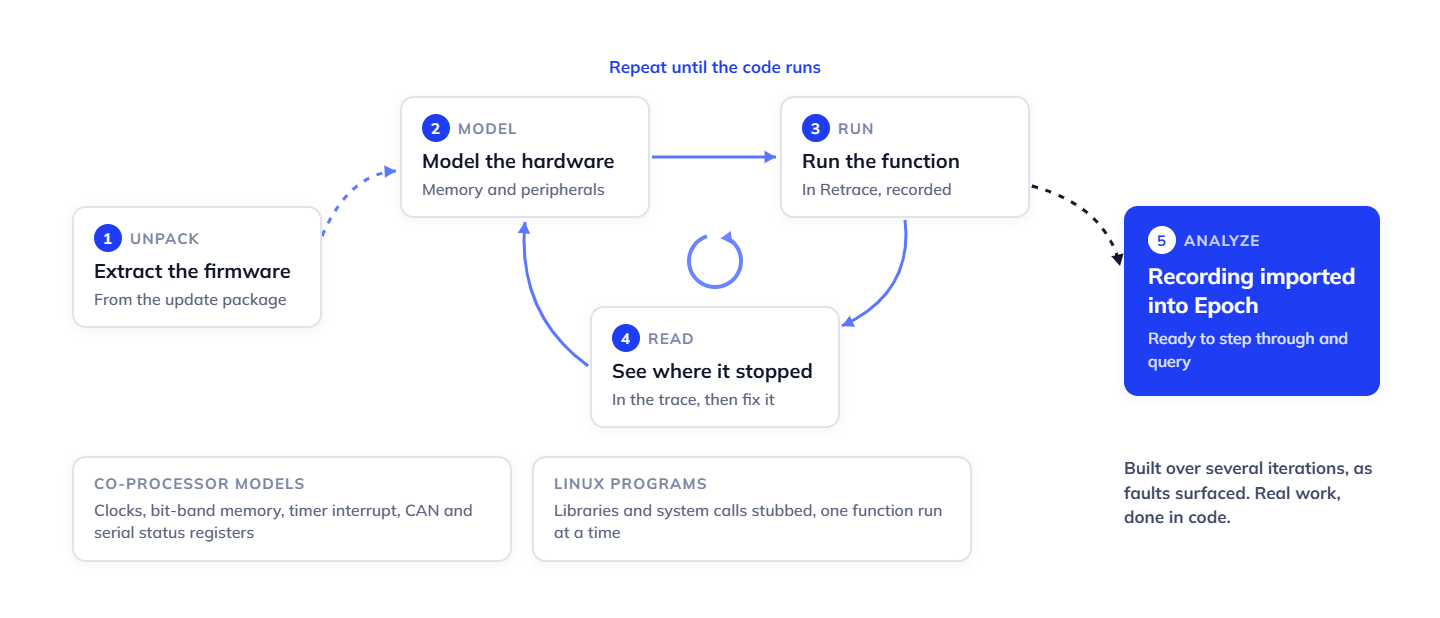
Rehosting means running the firmware's own code without its original hardware, by modeling the memory map and peripherals the code expects to find. That modeling is real work, not a switch to flip: the co-processor needed written models for its clocks, its bit-band memory, its timer interrupt and its CAN and serial status registers, built up over several iterations as faults surfaced, and the Linux programs needed their libraries and system calls stubbed. In this project an AI agent did all of it in code (unpacking the firmware, writing the harness and peripheral models, running the functions, recording the trace and importing it into Epoch) with no person carrying out those steps and no physical device on a bench. The point is not that rehosting became effortless; it is that the work it takes was done in software, start to finish, on an IoT target with its own co-processor.
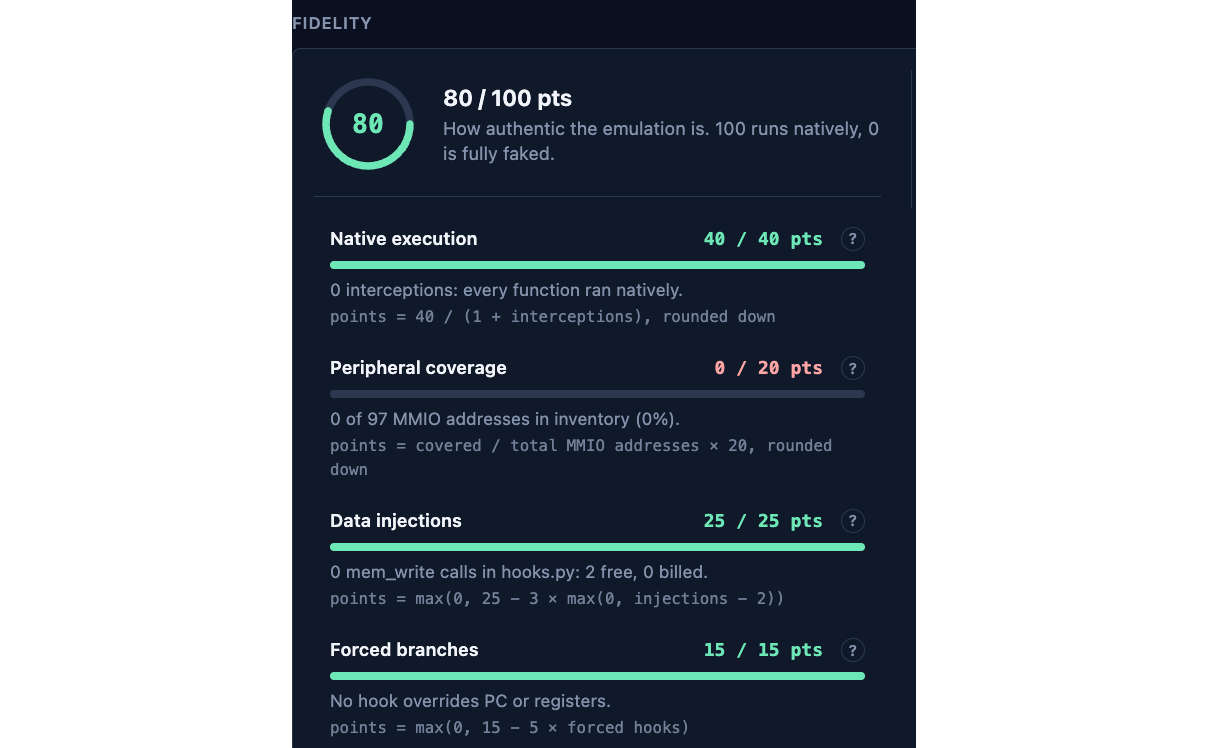
Epoch is where that recording turns into proof. A key question in security analysis is whether input data is processed safely and whether security controls behave as expected, and Epoch answers it directly: take the byte the test input started as and follow the data throughout execution to understand its propagation and how the application processes it. This is how we separated a real fix from an incomplete one.
The recording also captures the behavior that a fix is supposed to change. For an overflow scenario, we replayed the same input against both versions in Retrace and measured how far it wrote past the record: 179 bytes in 5.1.1, nothing in 5.4.0. That is a before-and-after a reviewer can reproduce, not a description of one.
5.1.1's unbounded copy carries the over-long username past the end of the session record into neighboring stack memory, while 5.4.0's length-capped copy stops inside the field, so the same request changes nothing beyond the record.
None of this needed the physical controller, and that is the point. Retrace took the application binaries straight from the update package (one of them 72 MB), rehosted them, and ran individual functions under full time-travel recording, with no board on a bench. Epoch then made each recording interrogable: step through the run, search every memory access, and follow a value from where it entered to where it was used. Between them they turned a static firmware blob into a system we could question and get answers from in an afternoon, and the Danfoss package is only one example of a workflow that applies to any firmware.
A few ways this shifts firmware security from occasional to routine:
These are real controllers, still exposed and still being attacked, so we are handling the specifics carefully. Technical details of newly identified security concerns have been shared confidentially with the vendor and the relevant CERT as part of the coordinated disclosure process, not published in a blog post, and we did not use the credential we found. The value here is the method, not a recipe for misuse.
The broader lesson is simple. When a security update ships, "trust us, it's better" is not good enough for devices that keep food cold and stores running. With the right tooling you can open the firmware, run it, follow the data, and see for yourself, in an afternoon. If you build, deploy, or defend embedded systems and want to check what an update really does, this is the kind of analysis Retrace and Epoch were built for, and we would be glad to show you.
Our team will show you how Epoch fits the way you work.
Want to explore first? Test the Epoch engine at ttd.eshard.com. Free, no sign-up, no credit card.
Our team will show you how Epoch fits the way you work.
Want to explore first? Test the Epoch engine at ttd.eshard.com. Free, no sign-up, no credit card.
A practical framework on protecting autonomous systems against physical access, implementation attacks and cross-layer compromise.
