Hugues Thiebeauld
|
0
|
May 19, 2026


esDynamic 2026.4 is a foundation release. It pushes the platform forward on the things analysts touch every day, connecting lab equipment, accessing state of the art knowledge, visualizing tracing and performing security assessment and cryptography evaluation.
Side-channel and fault injection analysis live at the intersection of three demanding worlds: high-volume signal processing, deep cryptographic know-how, and very real lab hardware. Every esDynamic release tries to make those three worlds easier to work in, and easier to combine.
2026.4 is no exception: a new trace visualizer fully redesigned, an expanded set of expertise modules covering the latest attack research, a substantial upgrade to the post-quantum cryptography content, two new families of supported lab equipment, and a quietly modernized platform underneath it all.
.gif)
Insight, the fully reworked trace visualizer that ships with 2026.4, was built to address one of the most critical side-channel operations: visualizing the traces.
Four things that make the difference:
The result is a tool that fits both the exploratory phase of an analysis, when you don’t yet know what you are looking for, and the production phase, when you need to script the same operation across millions of acquisitions.
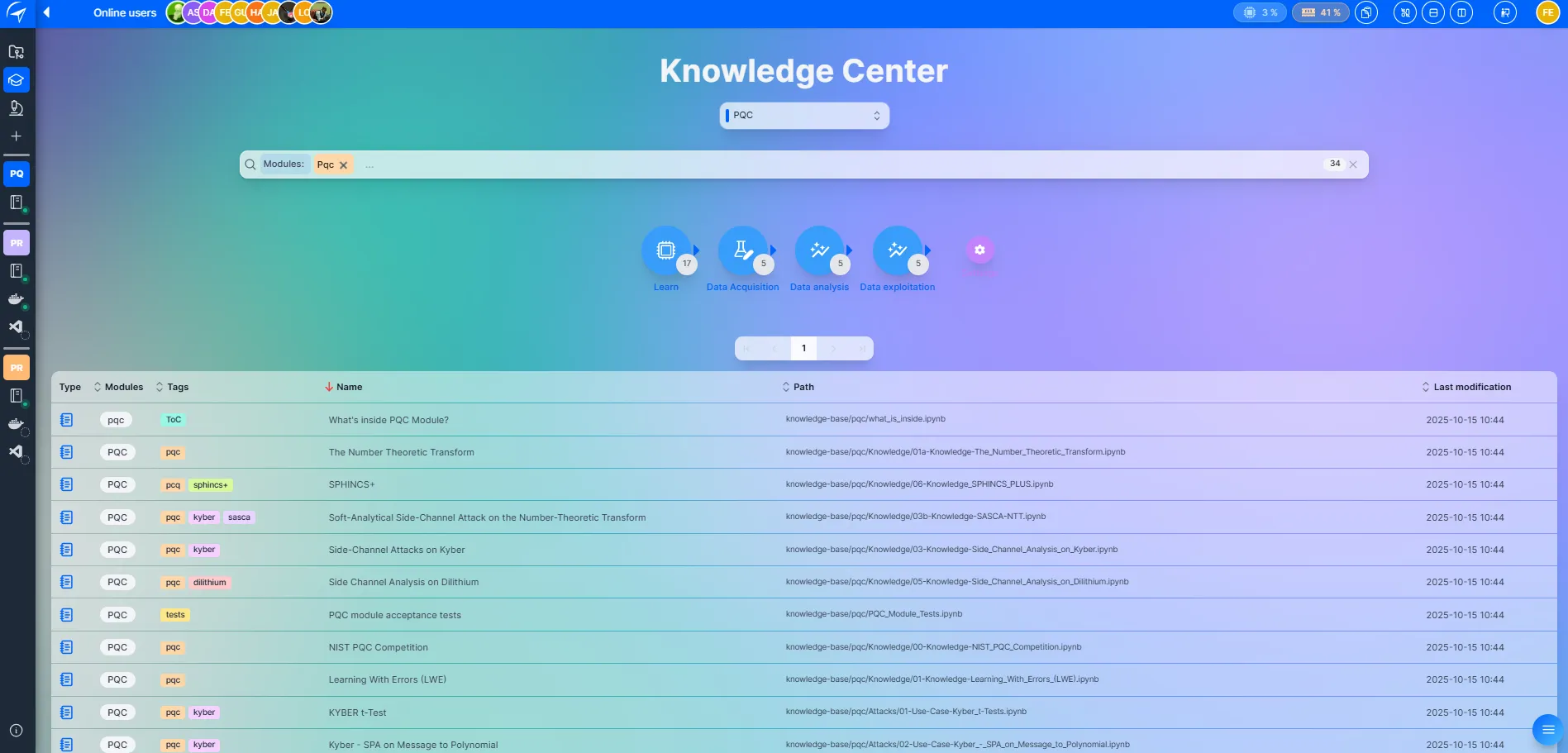
Expertise modules are how esDynamic turns years of attack research into ready-to-use, executable knowledge. Each module combines theory, reusable building blocks, and notebooks that can be run on real targets.
2026.4 brings substantial new content across four flagship modules:
If a single highlight defines this release, it is the PQC module. Post-quantum cryptography is moving fast, and security evaluation needs to keep up.
The 2026.4 PQC module brings:
The PQC module now covers the full lifecycle of a post-quantum security evaluation, from the underlying mathematics all the way to combined SCA and fault injection attack scenarios.
Bench Manager, the part of esDynamic that talks to your lab hardware, keeps expanding its native support. With 2026.4, two major instrument vendors join the list:
For labs running mixed setups, this means fewer scripts to maintain, fewer brittle integrations, and more time spent on the analysis itself.
Platform improvements rarely make the cover of a release post, but they are what users feel every day. 2026.4 sharpens three areas:
Small, individually. But together, they mean less friction for the analyst, and less administration overhead for the people running the deployment.
esFirmware, our pre-silicon testing tool for evaluating software binaries against physical attacks — side-channel analysis and fault injection, is now an independent tool available on the platform like any other resource.
Built on an extended QEMU emulator and driven from a familiar Python and JupyterLab environment, esFirmware lets security teams validate countermeasures early in development, generate datasets for attack research, trace leakage down to the exact leakage / faulty instruction, and automate the whole thing inside CI pipelines. It supports Intel (x86/x64), Arm (Arm32/Arm64) and RISC-V binaries.
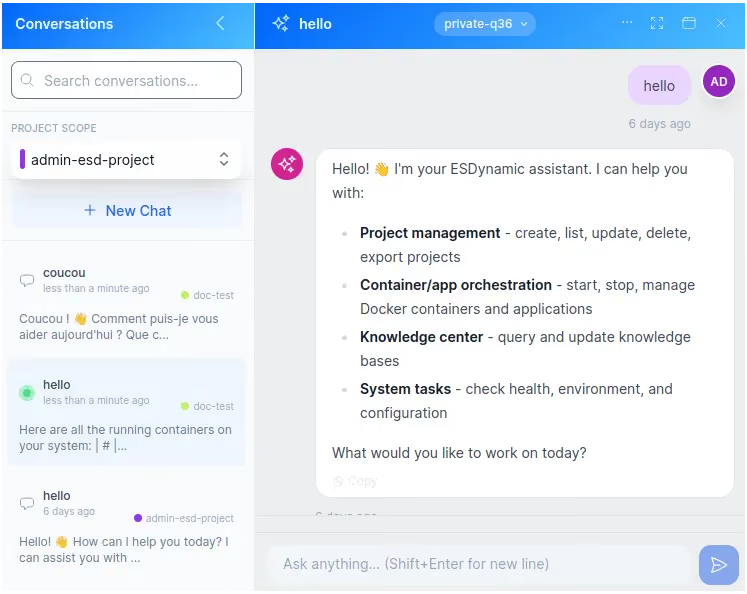
Two themes are already shaping the next releases. The fault injection widget will bring more interactivity and depth to FI analyses, and we are actively working on bringing agentic AI into the side-channel and fault-injection workflow to make analyst work deeper, easier.
2026.4 lays the groundwork for both. Better visualizations, a richer knowledge base, modern infrastructure, and broader hardware coverage, all of these are prerequisites for what is coming.