Aurélien Vasselle
|
0
|
January 23, 2023


We are pleased to announce that our research on advanced side-channel analysis techniques has been accepted and published in the Journal of Cryptographic Engineering, one of the leading peer-reviewed publications in applied cryptography and hardware security.
The paper presents improvements to side-channel analysis techniques, with a focus on practical attacks against protected cryptographic implementations. Specifically, we study the impact of operation shuffling countermeasures on the effectiveness of side-channel attacks, and how these protections can be overcome.
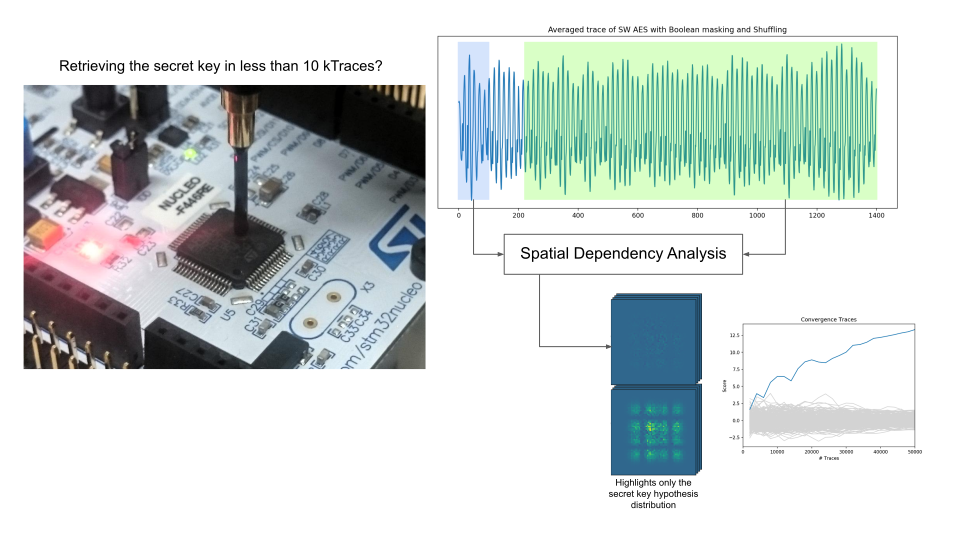
To support reproducibility and further research, we are releasing one of our experimental datasets on our GitLab repository. It contains electromagnetic side-channel traces of a software AES implementation running on an STM32F4 microcontroller (Cortex-M4), protected by Boolean masking and SubBytes operation shuffling. A Jupyter notebook detailing the full acquisition campaign is included.
The traces offer strong leakage signal with no clock jitter and plenty of points of interest — but the combination of masking and shuffling spreads information across many time samples, making key recovery genuinely challenging.
We are releasing this dataset as an open challenge. What would your approach be? How many traces would your technique require, and how distinguishable is the secret key? We want to motivate the community to build on our work and push these techniques further.
In a follow-up post, we will share our own results alongside findings submitted by the community. Send us your ideas and results at contact@eshard.com — we look forward to hearing from you.